
Why do we still see some countries racing to restrict abortion or impose near-total bans? This article explores the multifaceted issue of abortion, addressing its moral, social, and philosophical dimensions. It challenges the persistent perception of abortion as equivalent to murder, shedding light on the physical, emotional, and societal burdens that pregnancy places exclusively on women. Through philosophical arguments, the article underscores the fetus's dependency on the woman, arguing that abortion is a deeply personal decision that must remain free from state or societal interference.
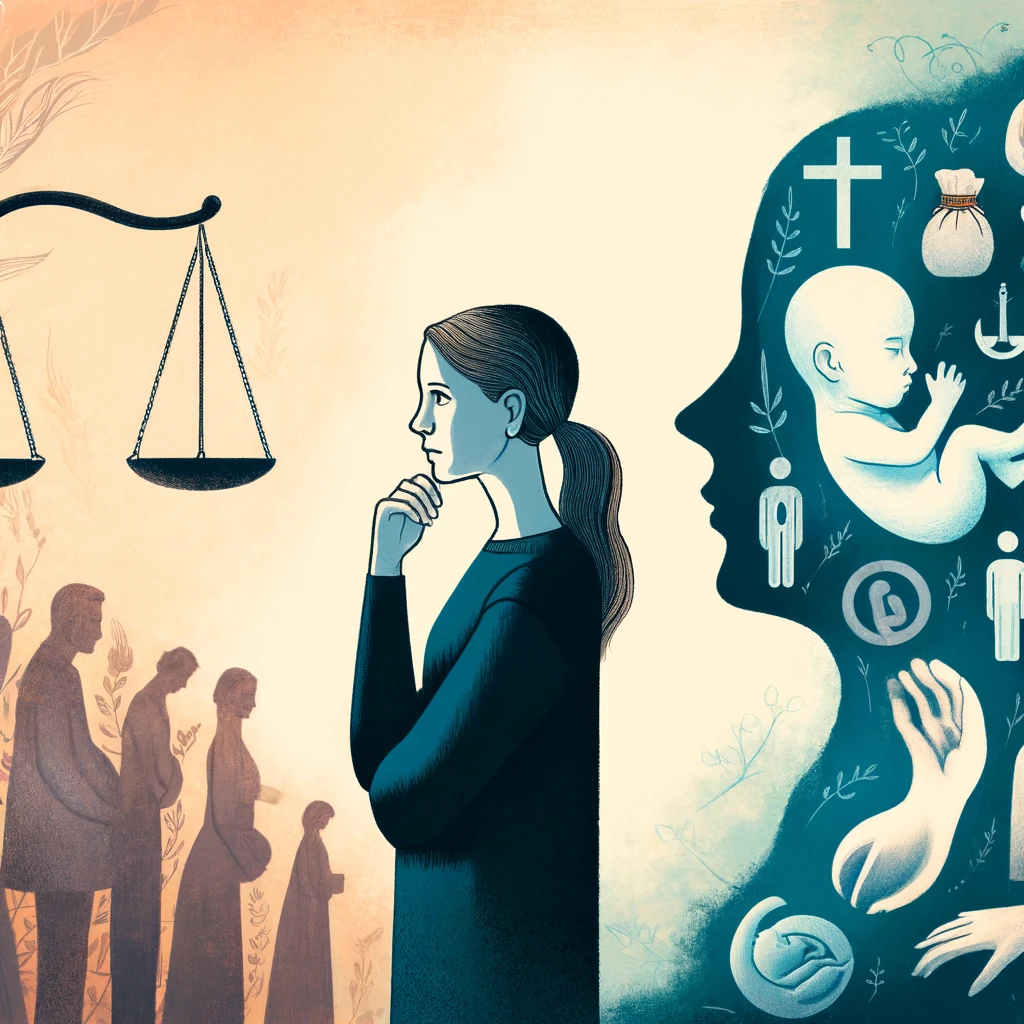
Abortion is a complex issue that confronts us with all the debates about life and freedom. There is a very wrong perception against abortion in society and religions. It is very likely that the person who has an abortion will be called a murderer, regardless of her emotional and physical situation. We witness that the approach that opposes abortion in the name of preserving the life of the fetus sacrifices and trivializes freedom. For these people, the freedom of the individual is caricatured, and it is thought that those who have abortions do not take life seriously.
Most people see abortion as an immoral act, as the author mentioned. Abortion would be unethical because the embryo is potentially a human being and it deserves to be respected like any other. However, it is very unreasonable to prohibit immoral behavior through religion or law. According to Kant, lying is not an ethical behavior, but people can choose to do so. Likewise, abortion may not be a moral act for some, but people can still choose to do it. In addition, as the author mentioned, the life trajectory of this creature that forms in the womb of a pregnant woman, unlike other creatures, depends on the life trajectory of the woman carrying it. Therefore, this embryo is not independent, its life is shaped according to the wishes of the woman it lives in. As the author said, this fetus is an addicted creature that consumes the woman's blood, hormones, and other resources it may need. In other words, defining this creature as an independent potential human is a very hasty approach.
If we look at the biological potential of the woman, in fact, all the resources that may be necessary for this early human are within the woman's body. The consumer of these resources is the fetus. As stated by the author, contrary to the prevailing understanding, the fetus does not grow in a bowl independently of the mother. The woman gives him life, so to speak. In the abortion process, however, the woman does not take the life of an independent person, as the author gives an example, this is not the same as killing a man in the street. Why? Because this man does not carry out his life cycle with her help, but the fetus in the woman's womb clings to life thanks to her. The woman simply stops helping and the fetus dies because it cannot be a self-suffıcıent creature.
Pregnancy is a very difficult and lonely process for the woman, although she does not have to take the responsibility alone. Based on the experiences of her relatives, the author explained how painful processes can be experienced in terms of health. In addition, the number of people who can say "I had a very comfortable pregnancy - I am going through" is very small. Therefore, women who can maintain a pregnancy should also be respected. The needs of the pregnant woman are no longer just her own needs, on the contrary, they become common needs. The baby needs it, and the mother begins to need it too. In addition to all these physical changes, extraordinary things, and generous sharing, women sometimes do not want to be mothers. What’s more, women may not want to accept motherhood roles imposed by society. Maternal roles, which are more or less the same, may become more difficult from society to society, and women may not want to take on such heavy responsibilities.
It is also useful to look at the situation from an emotional point of view. Motherhood is a phenomenon that changes a person's mentality and perspective on life. It can also bring along emotional states such as constantly thinking about the person you create, constantly thinking about him even if you are separated from him. The choice of women who do not want to bear this burden and who do not want to change their identity with their mother's identity should be respected. There is another group of women that I would like to talk about very briefly. They do not want to be mothers because of the physical disorders that pregnancy will bring (such as weight gain) and they have an abortion. In the text, the author says that to do so is not right and even immoral. Unfortunately, I do not agree with this opinion. People may attach great importance to their appearance and may not want a situation that is woven with physical changes during the 9 months of pregnancy. Not wanting to be a mother should be understood by focusing on these profound changes that the woman goes through, rather than being associated with murder.
If we look at the privacy of pregnancy, as the author states, pregnancy is as private as sex. If we look at motherhood, it is the privacy of both the person and the couple. Therefore, it is not acceptable to ban abortion by the state due to ideological and political concerns. The state that bans abortion is for me the one that interferes with people's privacy, manages people's sexual lives, and interferes with individuals' lifestyles. Allowing abortion legally cannot be seen as an unscrupulous and immoral attitude towards early human life, and prohibiting abortion legally cannot be glorified as a more conscientious and moral attitude.
As the author mentioned, not using birth control pills or not using condoms while there is a possibility is open to criticism, but despite all this, abortion is still the decision of the woman. In other words, should the person continue the pregnancy as a punishment for having sex without taking precautions? Human life is so valuable that we can deduce from this sentence it is a method of punishment for people. Or does a person have to bring a being into the world just because she has unconsciously had sex? It's like saying, "You had sex, so you owe the world a baby." Apart from this, some women want to get pregnant, which the author mentions, and who want to terminate their pregnancy due to unfavorable conditions. Here, women already think that they will not provide a good life for this early person and want to have an abortion. In this case, the main anxiety comes from the person herself, that is, one often worries about herself rather than worrying about the person who does not have a life already. He or she may not want to experience feelings of inadequacy. The possible anxieties of the woman may encourage her not to have given birth at all.
As a result, abortion is an issue that we can decide freely and voluntarily, like hundreds of issues such as our health, education, and shelter. A woman may want to protect herself against unwanted pregnancies, and both the state and the people should respect this. Because of the religious or moral acceptance of the majority, this very special and personal right and freedom of women should not be easily abolished. The woman should decide whether abortion is morally wrong. A certain morality cannot be imposed or enacted by force. The greatest immorality is the use of force. It is important to leave it to the woman to decide what the status of the fetus is. Individuals, in the context of their values, may not have an abortion if they think that the fetus is a vibrant early human life from pregnancy onwards. In addition, no one should judge women who do not have these thoughts or who still want to have an abortion.
BIBLIOGRAPHY
- Little, Margaret Olivia (2005). The Moral Permissibility of Abortion. In Andrew I. Cohen & Christopher Heath Wellman (eds.), Contemporary Debates in Applied Ethics. Malden, MA: Wiley-Blackwell. pp. 51-62.
https://philpapers.org