
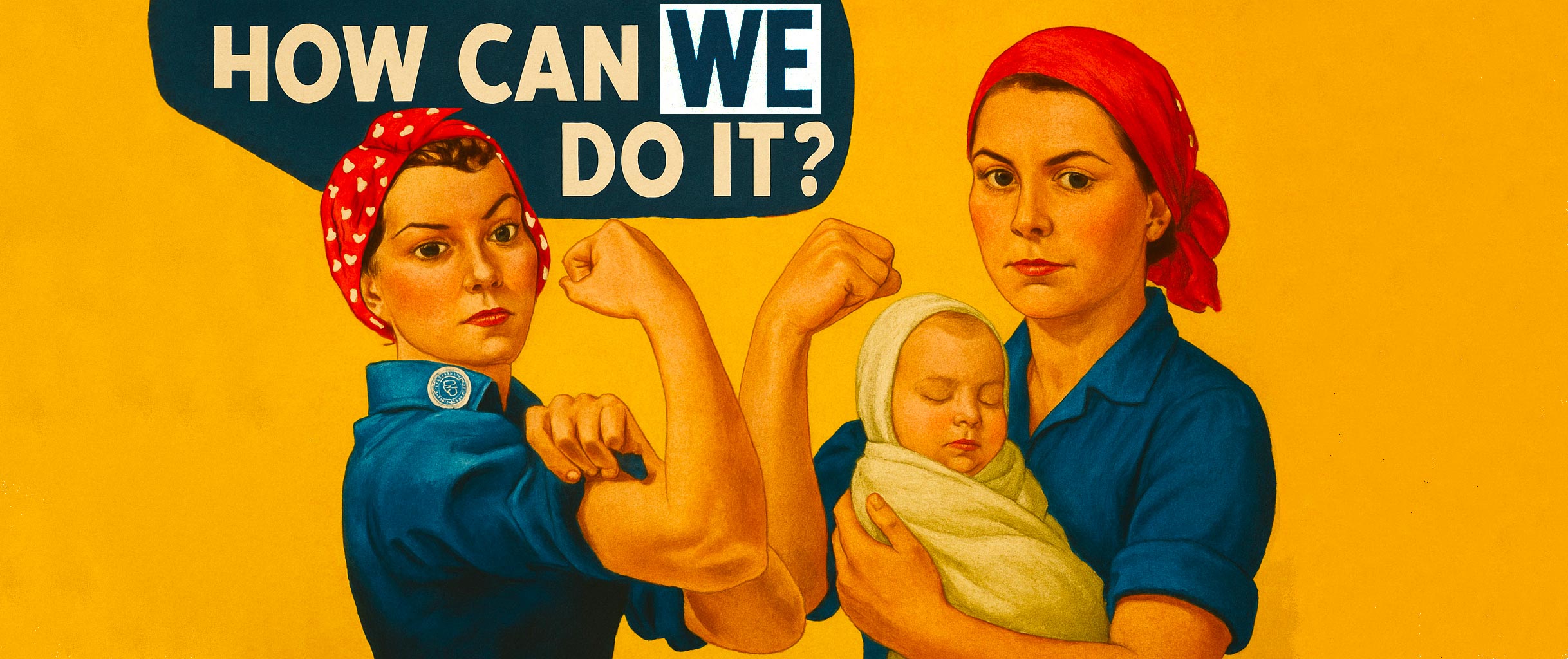
Let’s delve into the complex relationship between feminist thought and the experience of motherhood, past and present, and reveal how care work and motherhood are often left out of the conversation. This article challenges both the romanticization and denial of motherhood, calling instead for a feminism that values care, supports mothers, and confronts systemic inequalities. Through an intersectional lens, it asks us to rethink what freedom means when caregiving is at the center. Can a feminist future truly be inclusive if it leaves mothers behind?
Introduction
The question of how motherhood can be more fully integrated into feminist discourse, without reinforcing traditional gender roles, remains both urgent and complex. Across its history, feminism has wrestled with how to position motherhood within the struggle for gender equality. In its early waves, feminism often viewed motherhood as a site of patriarchal control, distancing itself from maternal identities to avoid essentialist notions of womanhood. Yet this distance, while strategic, also risked excluding the realities of those whose lives are shaped by care work, reproductive labor, and maternal responsibility.
Today, the need to re-engage with motherhood is clearer than ever. As feminist thought evolves, it must find ways to recognize maternal experiences without reinforcing the very norms it seeks to dismantle. This requires acknowledging that mothers face unique challenges from the motherhood penalty and gender pay gap to social stigma and lack of support, which are deeply shaped by gender, race, class, and other intersecting factors. Integrating motherhood into feminist discourse is not about returning to traditional ideals, but about building a more inclusive feminism that values care, challenges patriarchal assumptions, and creates space for all forms of maternal experience.
Early Waves of Feminism and Motherhood
Motherhood was frequently criticized by feminist theorists in the early feminist movements, especially in the first and second waves. For thinkers such as Betty Friedan (1963) and Simone de Beauvoir (1949), motherhood was a primary tool of patriarchal domination. In her 1949 book The Second Sex, de Beauvoir argued that women's biological reproductive capacity was socially controlled to confine them to domestic and caregiving responsibilities, thus limiting their potential and independence. Similarly, Friedan's 1963 book The Feminine Mystique criticized the idealization of motherhood as the pinnacle of female fulfillment, which often confined women to the home and prevented them from achieving their goals in both their personal and professional lives (Gunew, 2013).
The feminist emphasis on autonomy, self-determination, and freedom from the constraints imposed by traditional gender roles resulted in a detached attitude toward parenthood. Many feminists at the time believed that childbearing directly inhibited personal freedom and gender equality. However, this critique failed to take into account the lived experiences of mothers, especially when considering racial, social, and economic inequalities.
The Transition to Maternal Validation
There was a change in feminist thinking by the 1970s and 1980s. Thinkers like Adrienne Rich (1976) and Sara Ruddick (1989) highlighted the complex nature and transformative potentials of motherhood as second-wave feminism developed. According to Rich's 1976 book Of Woman Born, parenting can be a life-affirming and liberating experience that allows women to express their creativity and freedom when it is freed from patriarchal expectations. Similarly, mothering might be viewed as a way of thinking and political participation that could challenge social norms of care, dependency, and relationality, according to Ruddick's Maternal Thinking (1989).
Compared to previous feminist criticisms that associated motherhood with oppression, these contributions represented a substantial shift. Instead, it was becoming more widely acknowledged that motherhood was a place of social and political power that needed to be recovered from the patriarchal. This change brought attention to the potential for redefining mothering as a constructive force that might both challenge and change gendered norms (Ruddick, 1989).
Intersectionality and the Necessity of Including Mothers in Feminist Discourse
The critique of maternalism must also be situated within a broader intersectional framework. Feminist discourse often overlooks the compounded vulnerabilities faced by mothers, particularly those who are economically disadvantaged, racially marginalized, or living in contexts where the social support for caregiving is minimal. Intersectionality, as articulated by Kimberlé Crenshaw (1989), emphasizes how race, class, and sexuality intersect with gender to create unique experiences of oppression. This is particularly relevant when discussing the experiences of mothers, whose labor is often undervalued and whose struggles are exacerbated by broader social and economic inequities (Bartlett, 2016).
Mothers, especially those from marginalized communities, face systemic challenges that cannot be separated from their role as caregivers. The lack of paid parental leave, affordable childcare, and financial security disproportionately affects mothers in lower-income and minority communities, reinforcing their vulnerability within a patriarchal society. Moreover, the patriarchal structures that limit women’s autonomy also severely restrict mothers’ access to the resources they need to thrive. Therefore, feminism must embrace a more inclusive approach that acknowledges the multiple layers of oppression faced by mothers, rather than relegating them to the margins of feminist discourse.
Reimagining Motherhood in Feminist Discourse: Accepting Complexity and Care
To properly integrate maternity into feminist discussions, we must move beyond both maternalist rhetoric, which idealizes motherhood, and traditional feminist critique, which sees it as a barrier to gender equality. Scholars such as Alison Bartlett (2016) call for a postmaternal feminist paradigm that recognizes the various aspects of motherhood while rejecting essentialist or patriarchal notions. This paradigm enables feminism to understand motherhood as more than just a biological or institutional duty, but rather as a multifaceted, socially constructed experience that links with larger political, economic, and cultural influences (Bartlett, 2016).
Central to this reimagining is the recognition of caregiving labor as a vital component of feminist thought. Heather Jon Maroney (1985) expands the feminist framework of reproductive justice, which not only encompasses the right to abortion and contraception but also highlights the need for safe, supportive environments for raising children. By advocating a redistribution of care responsibilities across society, this approach challenges neoliberal ideologies that devalue care work and encourages a more collective and inclusive understanding of motherhood.
According to Maureen Freely (2000), mainstream feminism has long disregarded the political relevance of motherhood, focusing on autonomy and career development rather than confronting the systemic injustices that mothers experience. These include gender pay disparities, insufficient maternity leave, and undervaluation of domestic labor. Julie Stephens (2012) challenges postmaternal theory, arguing that a truly inclusive feminist framework must interact with women' lived realities while avoiding both traditional maternal duties and essentialist ideas. Embracing reproductive justice, queer maternalities, and transnational feminist perspectives may help feminism create a better knowledge of care, reliance, and relationality, ensuring that mothers' various experiences are important to feminist liberation (Stephens, 2012).
Rethinking Motherhood within Feminist Discourse: Challenging Patriarchal Constructs and Essentialism
Feminist discourse must critically engage with patriarchal frameworks that have traditionally defined motherhood in narrow and restrictive terms. Patriarchal regimes have long presented maternity as a defining component of womanhood, often excluding women who are not mothers or have had less-than-ideal motherhood experiences. This essentialist viewpoint simplifies motherhood into a single narrative, portraying it as a responsibility and duty unique to women's identities. This framework not only reinforces conventional gender stereotypes but also ignores the diversity of maternal experiences across various social, economic, and cultural contexts (Bartlett, 2016). To overcome these restrictive frameworks, feminist philosophy must illustrate to everyone that not all women are mothers, and that even among mothers, experiences vary significantly.
At the same time, including motherhood in feminist discourse requires addressing systemic disadvantages that disproportionately affect women, particularly those generated by patriarchy. The motherhood penalty, economic insecurity, and gender wage inequities are essential issues that must be addressed via feminist lenses. Furthermore, barriers such as insufficient maternal healthcare, poor mental health support, societal stigma, and partners' unwillingness to share caring tasks exacerbate mothers' vulnerability. To address these inequities, feminists should campaign for inclusive policies such as paid maternity leave, affordable childcare, flexible work arrangements, and comprehensive maternal health care. These initiatives not only address the material realities that impact mothers’ lives but also challenge patriarchal institutions that isolate caregiving as a specific and feminine task, fostering a more equal and inclusive feminist future.
Conclusion: A More Inclusive Feminist Future
The challenge for feminism is to create a discourse that acknowledges and transcends traditional roles assigned to mothers. Feminism may produce a more just and equitable future by adopting an inclusive feminist worldview that recognizes mothers' intersectional experiences, values caring labor, and supports policies that accommodate their special needs. Incorporating maternity into feminist discourse does not mean perpetuating traditional gender roles, but rather reinventing what motherhood may be in a society that values care, dependency, and support. In doing so, feminism can pave the way for greater liberation for all women, including those who choose or are forced to mother.
BIBLIOGRAPHY
- Bartlett, A. (2016). Postmaternal times and radical feminist thinking. Australian Feminist Studies, 31(90), 486–500.
https://doi.org - Crenshaw, K. (1989). Demarginalizing the intersection of race and sex: A Black feminist critique of antidiscrimination doctrine, feminist theory, and antiracist politics. University of Chicago Legal Forum, 139–167.
https://www.researchgate.net - De Beauvoir, S. (1949). The second sex. Alfred A. Knopf.
- Freely, M. (1995). What about us?: An open letter to the mothers feminism forgot (Hardcover ed.). Bloomsbury.
- Friedan, B. (1963). The feminine mystique. W. W. Norton & Company.
- Gunew, S. (Ed.). (2013). Feminist knowledge: Critique and construction. Routledge Library Editions: Feminist Theory. Routledge.
https://www.routledge.com - Maroney, H. J. (1985). Embracing motherhood: The new feminist theory. CTheory, 9(1–2), 40–64.
https://journals.uvic.ca - Ruddick, S. (1989). Maternal thinking: Toward a politics of peace. Beacon Press. https://philpapers.org/rec/RUDMTT
- Stephens, J. (2012). Confronting postmaternal thinking: Feminism, memory, and care. Studies in the Maternal, 4(2). https://www.researchgate.net