
When floods destroy infrastructure or heatwaves strain health systems, who absorbs the hidden costs? Why do women, already carrying most unpaid care work, become the de-facto first responders at the expense of their rights, health, and livelihoods? And what if care itself were recognised as climate infrastructure, as vital as roads or energy grids? This article examines how climate change magnifies care demands and deepens gender inequality, while also pointing to solutions from Pakistan’s floods to Bangladesh’s cyclone shelters that show how centering care can turn vulnerability into resilience.
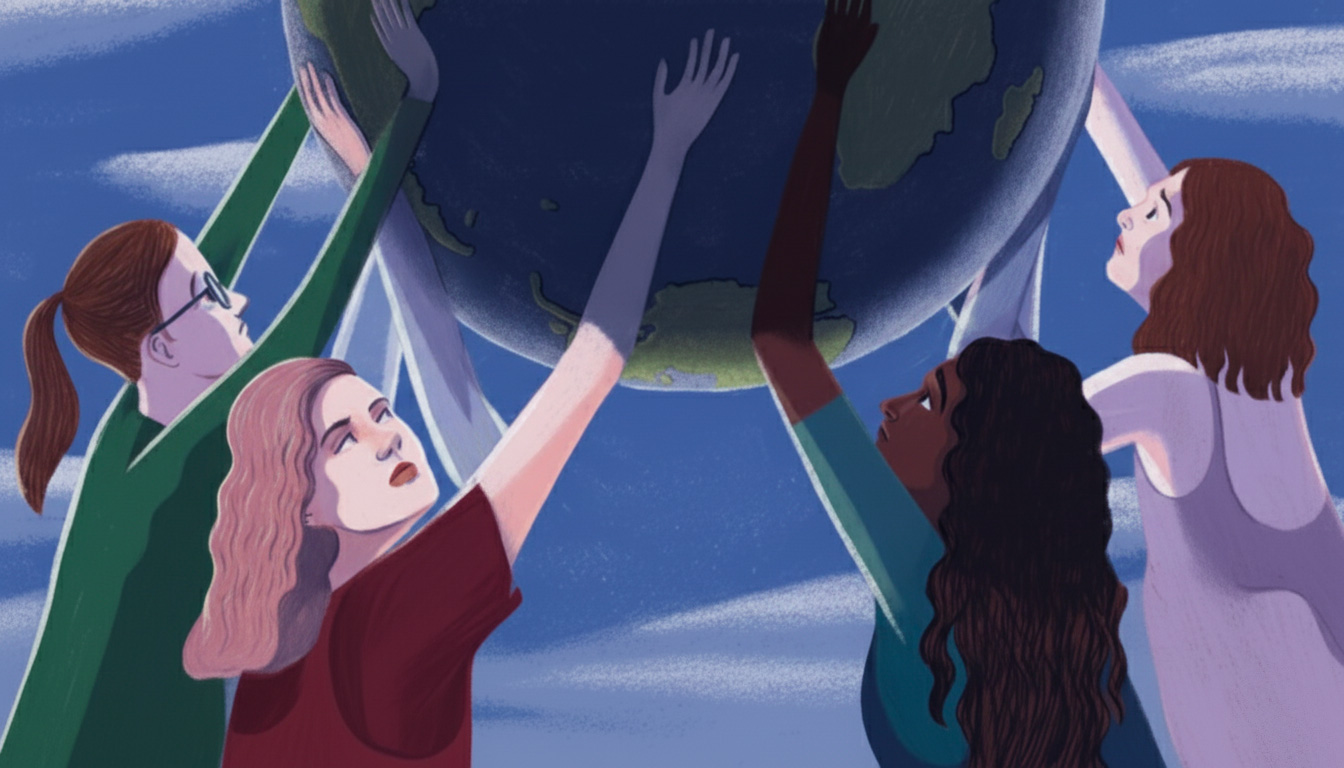

Gender, Care, and Climate
Climate change amplifies pre-existing gender inequalities by increasing the volume and intensity of unpaid care work. Caregivers, predominantly women, absorb additional household and community care needs when services fail or infrastructure is damaged, constraining their economic participation, undermining sexual and reproductive health, and limiting meaningful participation in governance. Unless adaptation and recovery interventions explicitly recognise and redistribute care responsibilities, climate action risks deepening structural inequality. This brief draws on international guidance, peer-reviewed literature, and two case studies (Pakistan 2022 floods; gender-responsive cyclone shelters in Bangladesh) to propose short, policy-oriented recommendations for rights-based, care-centred climate action (MacGregor et al., 2022; CEDAW, 2018).
Introduction
Unpaid care work underpins household survival and local resilience but is largely invisible in climate policy. Estimates place the global value of unpaid care work in the order of US$10–11 trillion annually, and women perform the majority of this labour worldwide (MacGregor et al., 2022). Climate shocks, floods, droughts, storms, heat extremes, and epidemics, heighten care needs (sick family members, displaced relatives, loss of water or fuel) while weakening public services that would otherwise mitigate those pressures. The result is intensified time poverty for women and girls, greater barriers to paid work and schooling, and heightened health and protection risks.
How climate change deepens rights-deprivations
Economic rights: time poverty and lost opportunities.
When women spend more hours on unpaid care, their capacity to engage in paid employment or training shrinks. Time-use studies show large gender gaps, especially in rural and low-income settings where women can spend up to 14 hours a day on care and domestic chores, many times more than men, creating clear barriers to economic independence (MacGregor et al., 2022; Oxfam, 2020). Adaptation programs that ignore care risks exacerbate these inequalities by asking women to participate in climate projects without compensating or reducing their care load.
Social and health rights: SRH and protection gaps.
Climate disasters disrupt health systems and supply chains, undermining sexual and reproductive health (SRH) services, contraception, and maternal care. UNFPA’s global analysis highlights how climate-related shocks jeopardise maternal and newborn health and raise risks of gender-based violence (GBV), while many NDCs and adaptation plans fail to cost or plan for SRH and GBV services during emergencies (UNFPA, 2023). This gap turns routine care into crisis care, increasing morbidity and mortality for women and newborns when services are interrupted.
Political rights: exclusion from decision making.
Women’s everyday knowledge about local water, food, and household resilience is rarely translated into a seat at the table for planning and governance. Gendered time poverty, lower educational access for girls in some climate-affected areas, and the assumption that women will participate unpaid all reduce meaningful representation in climate governance. Scholars argue that adaptation must institutionalise an ethics of care to make governance more inclusive and just (Bond & Barth, 2020). International guidance, most notably CEDAW General Recommendation No. 37 (2018), urges states to integrate gender-sensitive disaster and climate responses, but operational uptake remains uneven.
Pakistan: 2022 monsoon floods and care demands
The 2022 monsoon season submerged roughly one-third of Pakistan and affected about 33 million people; nearly 8 million were displaced at the crisis’s peak (World Bank, 2022; United Nations in Pakistan, 2022). Displacement and damaged infrastructure interrupted maternal health services, supply chains for reproductive commodities, and water and sanitation, amplifying caregiving demands in households and camp settings. UNFPA and humanitarian partners documented urgent needs for dignity kits, clean delivery kits, and scaled SRH services amid rising GBV risks, illustrating how large-scale flooding converts routine care responsibilities into life-threatening crises and how the absence of pre-existing care infrastructure worsens women’s rights-deprivations.
Key lessons: emergency responses must pre-position SRH commodities, finance GBV prevention and case management from day-one, and support community-level labour-saving interventions (water, sanitation, childcare) to reduce care overload during recovery.
Bangladesh: gender-responsive cyclone shelters (what works)
Bangladesh has a long history of cyclone risk and of building evacuation shelters; however, many early shelters were not gender-sensitive, deterring women from evacuating due to lack of privacy, separate sanitation, or lactation spaces. Revisions to policy and practice, guided by the Bangladesh Climate Change and Gender Action Plan (ccGAP) and donor-supported projects, have introduced female-friendly shelter design, women’s participation in Cyclone Preparedness Program teams, and community preparedness that explicitly accounts for women’s needs (Ministry of Environment, 2024). Qualitative evidence from evacuees shows that gender-sensitive facilities and women’s leadership in preparedness increase shelter use and reduce gender-specific risks during evacuations (Chowdhury et al., 2022). These reforms show that adaptation can reduce care responsibilities and protect rights when design intentionally centres care.
What must change to make climate policy care-centred?
Climate action that protects women’s rights and strengthens resilience should make care visible by integrating time-use and gender-disaggregated data into monitoring frameworks and adaptation plans. It should invest in care systems such as water, energy, childcare, and sexual and reproductive health services, treating these as core adaptation infrastructure rather than add-ons. Essential services, including SRH and GBV response, must be guaranteed in disaster preparedness and recovery to protect women’s health and safety during crises. At the same time, responsibilities need to be more fairly shared through social protection measures and support for care workers, ensuring women are not left to carry disproportionate pressures alone. Finally, climate governance should be inclusive and accountable, institutionalising women’s leadership and aligning with international standards such as CEDAW General Recommendation No. 37 and the UNFCCC Gender Action Plan.
Conclusion
Climate change is a multiplier of pre-existing social inequalities. When care remains invisible in policy, women, already responsible for the bulk of unpaid care, become the de-facto responders to climate shocks, with harms to their economic prospects, health, and civic voice. The evidence from Pakistan’s floods and Bangladesh’s shelter reforms shows both the depth of the problem and feasible policy pathways. A rights-based climate agenda must therefore recognise care as essential infrastructure, finance labour-saving public goods, guarantee SRH and protection services in emergencies, and redistribute care through social policy and inclusive governance. Doing so will protect women’s human rights and strengthen community resilience in a warming world.
BIBLIOGRAPHY
- Bond, S., & Barth, J. (2020). Care-full and just: Making a difference through climate change adaptation. Cities, 102, 102734.
https://doi.org/10.1016/j.cities.2020.102734 - Chowdhury, T. J., Arbon, P., Gebbie, K., Muller, R., Kako, M., & Steenkamp, M. (2022). Lived-experience of women’s well-being in the cyclone shelters of coastal Bangladesh. Prehospital and Disaster Medicine, 37(4), 437–443.
https://doi.org/10.1017/S1049023X2200070X - Committee on the Elimination of Discrimination against Women (CEDAW). (2018). General recommendation No. 37 on gender-related dimensions of disaster risk reduction in the context of climate change (CEDAW/C/GC/37). Office of the High Commissioner for Human Rights.
https://www.ohchr.org/ - MacGregor, S., Arora-Jonsson, S., & Cohen, M. (2022). Caring in a changing climate: Centering care work in climate action (Oxfam research report). Oxfam.
https://policy-practice.oxfam.org/resources/caring-in-a-changing-climate-centering-care-work-in-climate-action-621353/ - Ministry of Environment, Forest and Climate Change, Government of the People’s Republic of Bangladesh. (2024). Bangladesh Climate Change and Gender Action Plan (ccGAP) — final. UN Women (host).
https://asiapacific.unwomen.org/sites/default/files/2024-07/bd-ccgap-final-2024.pdf - Oxfam. (2020). Time to care: Unpaid and underpaid care work and the global inequality crisis. Oxfam International.
https://policy-practice.oxfam.org/resources/time-to-care-unpaid-and-underpaid-care-work-and-the-global-inequality-crisis-620928/ - United Nations in Pakistan. (2022). Pakistan: 2022 floods response plan.
https://pakistan.un.org/en/download/115254/197499 - United Nations Population Fund (UNFPA). (2023). Taking stock: Sexual and reproductive health and rights in climate commitments (global report).
https://www.unfpa.org/sites/default/files/pub-pdf/UNFPA-NDC-Global%20Report_2023.pdf - UNFCCC. (n.d.). The enhanced Lima Work Programme on Gender and its Gender Action Plan. UNFCCC.
https://unfccc.int/topics/gender/workstreams/the-enhanced-lima-work-programme-on-gender - World Bank. (2022). Pakistan floods 2022: Post-disaster needs assessment (PDNA) — main report.
https://thedocs.worldbank.org/en/doc/4a0114eb7d1cecbbbf2f65c5ce0789db-0310012022/original/Pakistan-Floods-2022-PDNA-Main-Report.pdf